 Histamine Tracker
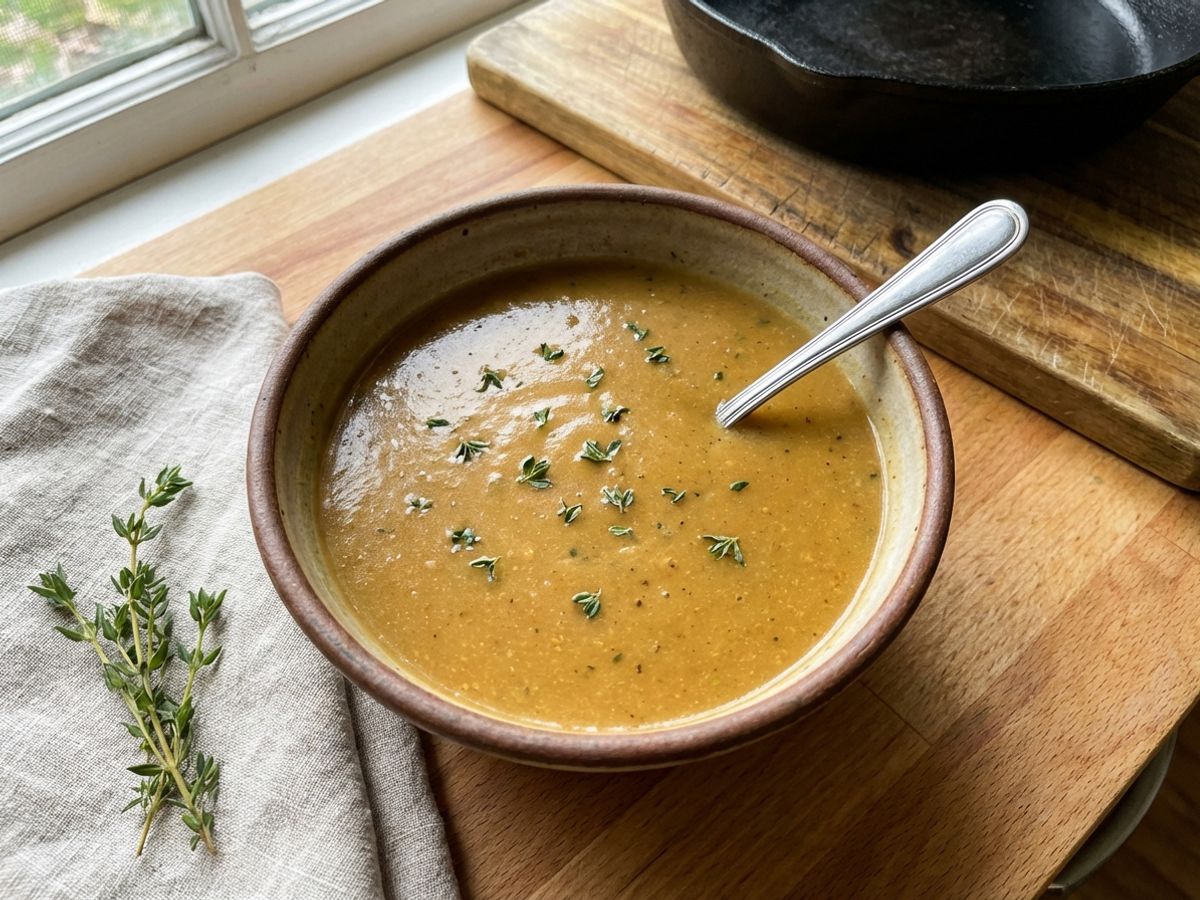
Simple Gravy

A simple gravy that comes together quickly after roasting chicken or turkey.
Ingredients
- 2 tablespoons pan drippings (or ghee if no drippings available)
- 2 tablespoons cassava flour
- 1 1/2 cups homemade chicken or vegetable broth
- 1/2 teaspoon fresh thyme leaves (or 1/4 teaspoon dried)
- 1/4 teaspoon salt
- Pinch of black pepper (optional, if tolerated)
Instructions
Make the Roux
- After roasting meat, pour off 2 tablespoons of pan drippings into a small saucepan. If you don't have enough drippings, add ghee to make up the difference.
- Heat over medium heat until warm.
- Whisk in the cassava flour until smooth and cook for 1 minute, stirring constantly.
Add the Broth
- Slowly pour in the broth while whisking continuously to prevent lumps.
- Add the thyme leaves and salt.
- Bring to a gentle boil, then reduce heat to low.
Simmer and Serve
- Simmer for 5 minutes, stirring occasionally, until the gravy thickens enough to coat the back of a spoon.
- Taste and adjust salt as needed.
- Serve warm over roasted chicken, turkey, mashed potatoes, or rice.
Tips & Substitutions
- No pan drippings? Use ghee or olive oil instead. The flavor will be slightly different but still makes a good gravy. Note that ghee is still a dairy product, though most milk solids have been removed.
- Cassava flour does not brown like wheat flour, so expect a paler gravy. This is normal and does not affect the taste.
- Simmer longer for thicker gravy. If it is too thin, keep cooking on low heat for another 5 minutes, stirring often.
- Use homemade broth for best results. Store-bought broths often contain yeast extract, preservatives, or other additives. Homemade chicken broth or vegetable broth works best.
- Swap cassava flour for arrowroot starch if you prefer. Mix the arrowroot with cold water first to make a slurry, then whisk it into the hot broth.
Why This Works
Pan drippings. Using fresh drippings from just-roasted meat keeps the gravy flavorful without relying on store-bought flavor bases that often contain problematic ingredients.
Cassava flour. Naturally gluten-free and works as a thickener without wheat, which many people with histamine intolerance are also sensitive to.
Homemade broth. Commercial broths often contain yeast extract, preservatives, and other additives. Using freshly made, quickly cooled broth is often better tolerated than store-bought options.
Fresh thyme. Generally well tolerated and adds a classic savory flavor. Fresh herbs may be better tolerated than dried for some people.
Storage
Best served immediately while warm. Gravy thickens significantly as it cools, and reheating can change the texture. If you have leftovers, refrigerate in a sealed container and use within 1 day. Reheat gently over low heat, whisking in a splash of broth to thin it back out. Since this contains protein-based broth, histamine can accumulate during storage.
Not sure if an ingredient is safe? Histamine Tracker includes a database of 1,000+ foods with histamine ratings to help you cook with confidence.


For educational purposes only. Not medical advice. Consult a healthcare professional for personal guidance.
References
- 13+ Low Histamine Flours & Grains — Low Histamine Eats
- Low Histamine Vegetable Stock — Through The Fibro Fog
- Low Histamine, Low FODMAP Vegetable Broth — Mast Cell 360
- Histamine and histamine intolerance — Maintz & Novak (2007)
- Histamine Intolerance: The Current State of the Art — Comas-Basté et al. (2020)
- Biogenic Amines in Plant-Origin Foods: Are They Frequently Underestimated in Low-Histamine Diets? — Sánchez-Pérez et al. (2021)
- Diamine Oxidase Supplementation Improves Symptoms in Patients with Histamine Intolerance — Schnedl et al. (2019)
- Histamine Intolerance — A Comprehensive Review — Jochum (2024)